


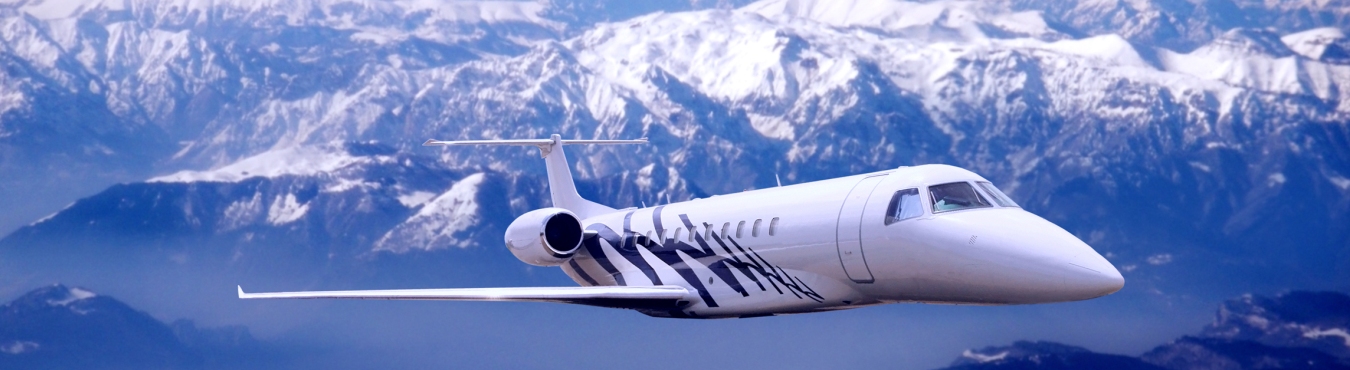
AIR CHARTER : Choosing an aircraft
You would need to view the entire charter fleet together, or else you would never know the range of choices you could have. The exact kind of charter aircraft that would be appropriate for your trip is decided by a number of factors like:
- The no. of passengers traveling with you.
- The amount and nature of cargo/baggage.
- The destination.
- Your aircraft preferences.
- Your budget
The most important question is how many passengers will be making the trip and the destination? The number of passengers will decide what size aircraft you'll need and your destination will indicate the required range. Some high-altitude airports have limited accessibility, or accessibility that changes seasonally depending on the aircraft.
Another factor is the crusiing speed. Cruising speeds can widely vary, but a rough speed estimate for propeller planes is about 200 mph/322kmh, while jets fly at something closer to 500 mph/805kmh. When estimating flight-times, add 10-15% for the time necessary to achieve cruising speed and altitude. You would need to give thought to your destination and how quickly you need to get there.
Choosing the right aircraft involves factors like size and passenger capacity, Aircraft performance and price. At first sight, the price might make the propeller driven plane more attractive, but then unless the aircraft has a lavatory, one might to make a pit stop. The noise level also has to be looked into. Thanks to pressurized passenger cabins in jets and flight altitudes where the noise of the engines drops off, making conversations at normal speaking volume is possible. The same isn't all that comfortable in a propeller plane flying at 7,000 feet. Feel free to talk to your broker or operator about your requirements and they will help find the correct aircraft for you.
Also, you should also intimate about any special cargo or quantity of baggage/ equipment you'll be bringing along. A safe flight depends a lot on appropriate weight and balance. Surprisingly, some items can cause trouble - skis, as an example, are too long to fit into the baggage compartment of most small aircraft. Operators are also not allowed to lay loose items such as skis in the aisle. Things like the presence of heavy smokers, or unusual equipment such as oxygen canisters or potentially flammable material should be intimated too.
PISTONPROP SINGLE-ENGINE
Pistonprop single-engine aircraft ideal for short-range flights with a few passengers or light load of cargo in good to fair weather conditions. A gas combustion propeller engine propells the Pistonprop aircraft. Pistonprops are usually smaller than other aircraft categories and therefore cannot fly as far without stopping for fuel. However, they can access many airports with shorter runways, getting the charter passenger closer to destination. Pistonprop single-engine aircraft are flown by a single pilot, but a charter broker usually provides a co-pilot upon request.
Usual Passenger Capacity: 3-4
PISTONPROP MULTI-ENGINES
Ideally suited for short-range flights for a small group of travellers or small cargo, Pistonprop multi-engine aircraft are are usually less relatively expensive than turboprops or jets. Pistonprop multi-engine aircraft are considered a lot safer and more reliable than single-engine piston aircraft, especially in unpredictable weather situations. Whereas pistonprop multis are usually larger than their single-engine counterparts and can carry more passengers, weight and cargo, they are still smaller than turboprops and jets. Pistonprop multi-engine aircraft are usually flown by a single pilot, but a a co-pilot can be provided upon request.
Usual Passenger Capacity: 1-5
TURBOPROPS
The advantage of Turboprop aircraft is that they combine the low-cost advantages of the piston aircraft at the same time sharing some of the performance and cabin-comfort advantages of light jets. Turboprops are powered by turbine-propeller engines. With average cruising speeds of above 300 mph and an average non-stop range above 1,000 miles, a turboprop can travel further, faster and offer more comfort than piston aircraft at the same time keeping charter costs below that of jet aircraft. Used for short to mid-range flights, turboprops can even access runways that are usually too short for jet aircraft. Amenities include safety and performance and a semi-private lavatory and pressurized passenger cabins for added comfort. However baggage capacity here is limited.
Usual Passenger Capacity: 4-8
LIGHT EXECUTIVE JETS
Light jets are the entry level jet class in the industry. Light jets are the most ideal choice for short to mid range trips. With average cruising speeds of 440 mph and an average non-stop range of about 1,500 miles, a light jet can usually travel further and faster than non-jet aircraft while operating in and out of airports inaccessible by the major airlines. Amenities usually include:pressurized passenger cabins , safety and performance and a semi-private lavatory. Light jets have limited baggage capacity and often cannot accommodate large golf bags or skis.
Usual Passenger Capacity: 4-8
MID-SIZE EXECUTIVE JETS
Midsize Jet aircraft blend comfort, performance and economy for medium-length flights. With average cruising speeds over 500 mph and a non-stop range of about 2000 miles, a midsize jet can travel further, faster and with more comfort then light jets while operating in and out of airports inaccessible by the major airlines. Most of the midsize jet aircraft have external baggage storage and can accommodate a reasonable amount of baggage. However, some aircraft only have internal baggage storage and can pose problems for skis and other bulky items. Most midsize jets offer private lavatories.
Usual Passenger Capacity: 5 to 9
AIRLINER - TURBOPROPS
Turboprops airliners merge advantages of a larger passenger cabin with turbo-prop performance. Popular for short to mid-range flights, they can land at airports with runways that are short for jet-aircraft and are usually economical than jet airliners. Turbo prop airliners are powered by 2 - 4 turbine propeller engines. In comparison with regular turboprop aircraft they possess more powerful engines and a longer non-stop range. Turboprop airliners also feature pressurized passenger cabins for added comfort, safety & performance. Some turboprop-airliners feature executive configurations with multiple amenities whereas others have commercial-airliner configurations to maximize passenger seating capacity. While majority of turboprop airliners are used for scheduled service, many are available through charter companies, brokers and charter divisions of airlines.
Usual Passenger Capacity: 19 to 65
AIRLINER - JET
Jet airliners are very much capable of carrying large-groups of people or heavy cargos on medium to long range flights paths. Smaller jet airliners are termed as "regional" and are suited for mid-range domestic transport, while larger jet airliners can carry hundreds of passengers for over thousands of miles non-stop. Jet airliners are usually powered by 2- 4 jet engines and feature pressurized passenger cabins that translate into added comfort, safety as well as performance. Jet airliners can be executive configured -- featuring multiple berths, a gym, lavatories, shower, meeting room and study, plus other luxurious appointments; or economy configured like a commercial airliner to maximize passenger capacity. While the majority of jet airliners are used for scheduled service, many are available through charter companies, brokers as well as charter divisions of major airlines.
Usual Passenger Capacity: 25 to 500+
HELICOPTERS
Helicopters or choppers have a distinct advantage - they can move into and out of difficult to reach places like big-city congestion or remote wilderness locations. Perfect for small groups of people that need to travel shorter distances in good weather conditions. Today's modern charter helicopters are usually powered by a single jet engine or dual jet engines and fly at speeds up to 175 mph for average ranges of 100-350 miles. Helicopter charter also enables passengers to hover over and take photographs of a real estate site, carry the injured to area hospitals, land in locations where airports ate unavailable and generally get in and out of places faster and easier than fixed-wing aircraft.
Usual Passenger Capacity: 3-10
Copyright © Air Charters India. All rights reserved.